Zee Drive Oxford
September 11, 2026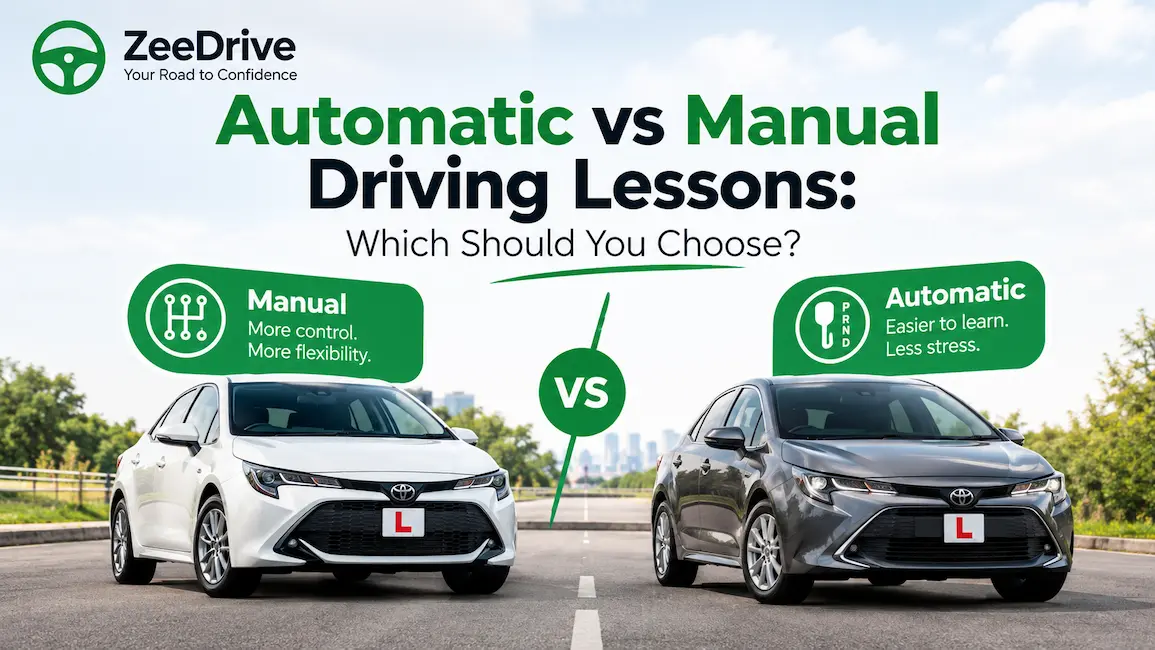
Automatic vs Manual Driving Lessons: Which Should You Choose in 2026?
Most learners assume automatic is the easier route to a driving licence. The DVSA’s own data tells a different story. In 2024–25, manual candidates had a 48.4% pass rate, compared with 43.1% for automatic. That gap surprises many learners, and it is worth understanding before you choose.
The decision is not just about gears. It affects your budget, your freedom to drive different cars and your future options. Automatic lessons cost more per hour but may require fewer hours. An automatic-only licence restricts you to automatic cars. At the same time, nearly all electric cars are automatic. Add long test waiting times and pressure from parents or peers, and choosing the wrong route can become an expensive mistake.
This guide cuts through the confusion with the real DVSA pass-rate data, an honest total-cost comparison and practical guidance based on your age, confidence, budget and future car plans. By the end, you will know which route fits you best and how to prepare for it properly.
Manual vs Automatic Licences: The Core Difference
The Two Licence Types Explained
A manual licence gives you the broadest choice. You learn in a car with a clutch pedal and gearstick, and passing the test allows you to drive both manual and automatic cars.
An automatic licence is more restrictive. You learn in a car without a clutch pedal or manual gear selection, and passing the test allows you to drive automatic cars only.
That licence category is the most important point to understand before choosing. It determines what you can legally drive after you pass, not simply what you learn during lessons.
The practical test follows the same basic structure for both routes. The key difference is the type of car you take the test in and the licence you receive afterwards. The theory test is also identical for both.
What an Automatic-Only Licence Means in Practice
With an automatic-only licence, you can buy, hire or borrow an automatic car. You cannot legally drive a manual car, even if you need to in an emergency.
That can matter more than you expect. You could be unable to borrow a parent’s manual car, drive a manual work vehicle or hire a manual van for a house move.
Many learners only think about this restriction after passing. It is why your future driving needs should be part of the decision from the start.
The Gearbox Basics: What You’ll Learn in Each
Manual lessons involve clutch control, gear selection, hill starts and recovering from stalls. These are often the parts that make learning feel intimidating, particularly for anxious learners.
Automatic cars remove the need for clutch control and manual gear changes. This lets you focus more directly on steering, observation, speed control and road positioning from the start.
So, an automatic can feel easier behind the wheel.
But easier to operate does not necessarily mean easier to pass. The DVSA test data tells a more complicated story, which we’ll look at next.
The Pass-Rate Reality: What the DVSA Data Actually Shows
The Counterintuitive Numbers: Manual 48.4% vs Automatic 43.1%
The headline figures are clear. According to the DVSA’s 2024–25 pass-rate data, dataset DRT122A, manual candidates passed at 48.4%, compared with 43.1% for automatic candidates. That is a 5.3 percentage-point gap.
It goes against the common assumption that an automatic test is easier to pass.
Automatic testing is also becoming much more common. Its share rose from around 6% of tests in 2018–19 to 12% in 2024–25. In 2025–26, automatic tests accounted for 29.4% of all car tests, according to the AA’s analysis of DVSA releases, with the automatic pass rate reaching 44.6%.
The numbers are worth knowing, but they do not mean manuals are inherently easier to pass.
Why Automatic Candidates Pass Less Often (It’s Not the Gearbox)
The difference is largely a cohort effect.
Automatic learners tend to be older, with a mean age of around 26 compared with 19 for manual learners. They are also more likely to be anxious about driving or to have switched to automatic after finding manual difficult.
That changes who is taking each type of test. The lower automatic pass rate reflects the characteristics and experience of the candidates as much as the car they are driving.
Manual learners tend to be younger and more confident, giving that group a genuine pass-rate advantage.
So if you are young, confident and comfortable learning clutch control, the manual figures are a relevant advantage for you. They are not proof that every learner will find manuals easier.
The Changing Test Landscape: Automatic’s Rising Share
Automatic tests have moved from a small minority to nearly a third of all car tests in under two decades.
The rise reflects changing learner preferences and the shift towards electric vehicles, which are almost universally automatic. As more learners choose automatic, demand for automatic instructors and tests also increases.
Automatic instructors remain a minority of the instructor workforce. That can affect both availability and pricing, particularly where demand is high.
The choice is therefore changing. Automatic is no longer a niche route, but its growing popularity does not remove the need to consider availability, cost and your own circumstances.
Final Verdict and Next Steps
A Quick Summary of the Decision
If you are under 30, reasonably confident and unsure, lean towards manuals. It keeps every option open, and the pass-rate advantage is real for that learner group.
If you are anxious, older or certain your future is automatic or electric, automatic can be a legitimate lower-stress choice.
Whatever you choose, two things are non-negotiable: understand the licence restriction before committing, and budget for total spend rather than the hourly rate.
Your Action Plan
- Check the latest DVSA pass-rate data and local prices for manual and automatic lessons.
- Assess the four decision factors: age, confidence, budget and future plans.
- Compare several local instructors and build a total-cost budget.
- Book your theory test and start hazard-perception practice using official DVSA resources.
- Add private practice where possible, with the correct learner insurance and supervision.
- Use DVSA's Ready to Pass guidance to decide when you are genuinely ready for the practical test.
Last updated: September 2026
Pass-rate figures and cost information should be reviewed regularly against the latest DVSA releases and advertised local instructor rates so this guide remains accurate as prices and testing trends change.