Driving lessons didcot Your Complete Local Guide to Passing First Time
September 28, 2026
Automatic vs Manual Driving Lessons in Abingdon: Which Should You Choose in 2026?
You are ready to start driving lessons in Abingdon, but one decision comes before you even book your first two hours: automatic or manual?
It is not a trivial preference. Your choice dictates what cars you are legally allowed to drive later, how many hours you will spend in the passenger seat, and how much cash leaves your bank account before you ditch your L-plates.
If the thought of stalling on the approach to Marcham Road roundabout makes your stomach drop, choosing an automatic sounds like an immediate relief. You are far from alone. Automatic tests accounted for 29.4% of all UK driving tests in 2025/26—a steep rise from roughly 4% in 2007/08. In fact, 41% of automatic learners cite plain convenience as their main motivation. Fewer pedals simply means fewer things to manage when traffic gets heavy.
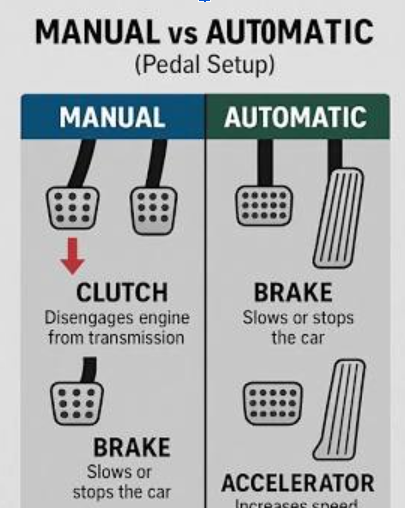
Manual vs automatic pedal setup. Source: Facebook
Yet an automatic does not magically make driving easy. It removes clutch control, but it does not remove the need to read road signs, judge approach speeds, or manage tricky lane discipline through the center of town.
This guide sets out the practical differences between both licences without the marketing spin. We will look at:
- Licence rules: What Category B versus Category B Auto actually permits you to drive.
- Pass rates and real hours: Why the national automatic pass rate surprises most people, and how long training takes in practice.
- The cost reality: Hourly rates versus total spend, plus post-pass insurance and car prices.
- Local test conditions: How both transmissions handle Abingdon test routes, from rural country lanes to dual-carriageway merges on the A34.
- Finding the right instructor: What questions to ask before handing over a block-booking payment.
By the end, you will know which route aligns with your budget and your future car plans. Read through, weigh the trade-offs, and use the decision checklist near the end to make your pick with confidence.
Automatic vs Manual: What Each Licence Actually Allows
When you pass your driving test, the DVLA does not simply hand you a generic licence. The vehicle you sit your test in determines your legal driving entitlement for life—unless you take another test.
What an Automatic Licence Covers
Passing in an automatic gives you a Category B licence with a Code 78 restriction noted on the back.
- Automatic and semi-automatic cars only: You are legally entitled to drive vehicles with two pedals (an accelerator and a brake).
- Zero clutch management: There is no clutch pedal and no physical gear shifting required. The vehicle manages gear selection for you.
Kvalty - Direct fit for newer cars: Virtually every electric vehicle (EV) and the vast majority of modern hybrids are automatic by design. An automatic licence aligns directly with where modern car manufacturing has gone.
- Strict manual ban: You cannot legally drive a manual car on UK roads. Doing so invalidates your insurance and counts as driving otherwise than in accordance with a licence.
Kvalty+ 1
Instructor Tip: Choose automatic if physical coordination or stalling anxiety dominates your lesson time, if your priority is getting road-legal as efficiently as possible, or if you already know your first car will be a hybrid or EV.
What a Manual Licence Covers
A manual test pass awards an unrestricted Category B licence.
- Complete vehicle flexibility: It covers both manual and automatic cars. You can step into an automatic anytime without extra training or administrative hurdles.
- Broader vehicle choice: It keeps options open for older second-hand runabouts, work vans, light commercial fleet vehicles, and European holiday hire cars.
- Mastery of physical controls: It requires learning clutch bite points, coordinated up-and-down gear shifts, and controlled hill starts under pressure.
- Permanent entitlement: Once you pass in a manual, you never need to retake a driving test to switch between gearboxes.
Instructor Tip: Remember that a manual licence covers both transmissions, but an automatic licence limits you to one. Think through what you realistically expect to drive over the next three to five years before committing your training budget.
Licence Restrictions and Future Car Plans
Your licence decision should reflect practical everyday use, not outdated driving myths.
Look at the vehicles you are likely to own or drive over the next decade. If your plan involves borrowing an older manual hatchback from your parents, taking a delivery or trade job, or buying a cheap runaround under £2,000, a manual licence remains the practical choice. It gives you the widest access to the budget end of the used car market.
If you plan to finance a newer car, commute locally, or move straight into an electric runaround, the restriction barely impacts daily life.
Switching later is always an option, but it is not a quick paperwork swap. Upgrading an automatic licence to an unrestricted manual requires paying for manual lessons, mastering the clutch from scratch, and booking and passing a full manual practical driving test. That means double the test anxiety and double the DVSA fees. Getting the choice right on lesson one saves real money.
Kvalty
The Abingdon EV Reality
Around Oxfordshire, the practical argument for learning manual is shrinking by the month.
Between low-emission planning, charging infrastructure expanding across south Oxfordshire, and the steady phase-out of traditional combustion engines, manual gearboxes are rapidly becoming a specialist preference rather than a daily necessity. For learners tackling local commutes between Abingdon, Culham Science Centre, and Oxford, an automatic licence is a future-proof credential. It strips out mechanical distraction so you can focus entirely on road position, cyclists, and traffic flow.
Automatic vs Manual at a Glance
| Factor | Automatic | Manual |
| Licence coverage | Automatic cars only (Code 78 restriction) | Both manual and automatic cars |
| Clutch and gear control | No clutch pedal; fewer things to manage in traffic and on hills | Full clutch control, gear selection, and hill starts required |
| National pass rate (2025/26) | 44.6% | 48.4% |
| Share of UK car tests (2025/26) | 29.4% | 70.6% |
| Typical lesson count | Around 35–45 hours plus private practice | Around 45–50 hours plus private practice |
| Hourly lesson cost (Abingdon) | £42 – £48 per hour | £38 – £45 per hour |
| Best for | Anxious learners, stop-start town traffic, EV focus, quicker test readiness | Maximum vehicle flexibility, older budget cars, trade or fleet work |
| Future car plans | Directly matches modern EVs and hybrids | Covers all consumer vehicles, ideal for driving older second-hand cars |
| Switching later | Requires taking regular lessons and passing a full manual driving test | No extra tests required; you can drive an automatic immediately |
What Learning Automatic Is Really Like
Clutch Control, Stalling, and Hill Starts
Stalling and clutch bite are the two hurdles that cause learners the most dread. When you stall at a set of lights in the middle of town with a queue of traffic behind you, panic sets in quickly.
An automatic car eliminates that problem completely. There is no clutch pedal. You select Drive, press the accelerator, and the vehicle moves smoothly.
- No stalling: You cannot stall an automatic by bringing a pedal up too fast.
- Controlled hill starts: Modern automatics hold on gradients without rolling backward. Creeping forward up an incline requires only steady pressure on the accelerator.
- Fewer physical controls to manage: Your left foot rests flat on the floor. Your hands stay firmly on the steering wheel instead of shifting gears every few seconds.
However, an automatic does not drive for you. Eliminating the clutch frees up mental bandwidth, but the actual driving skills remain unchanged: you still need sharp mirror checks, early lane positioning, smooth braking, and full steering control.
Instructor Tip: Do not fall into the trap of assuming an automatic guarantees an easy pass. In 2025/26, the UK automatic pass rate sat at 44.6%—trailing the manual pass rate of 48.4%. Quality instruction and observational discipline still decide your outcome.
Is Automatic Actually Easier? The Honest Answer
Automatic is simpler to control physically, but it is not inherently easier to pass the driving test.
The DVSA practical test assesses road safety, hazard perception, and priority decisions. An examiner does not award a pass for changing gears smoothly; they fail a candidate for misjudging oncoming traffic or missing a cyclist in a blind spot.
Automatic transmission removes physical workload, which can reduce panic in tight situations. But the test criteria remain identical.
Pass Rates and What They Really Mean
Automatic vs Manual Pass Rates (2025/26)
Official DVSA data shows how dramatically test choices have shifted across the country:
- UK automatic pass rate: 44.6% in 2025/26, showing steady improvement from 37.5% in 2007/08.
- UK manual pass rate: 48.4% in 2025/26.
- Surge in automatic testing: Automatic tests accounted for 29.4% of all UK practical tests in 2025/26—up from roughly 4% in 2007/08. That represents a 106% jump over just five years.
- Instructor availability: Roughly 1 in 4 instructors affiliated with national bodies like the AA and BSM now provide dedicated automatic tuition.
- Local test centre context: Abingdon learners typically sit their practical test at the Oxford (Cowley) test centre on James Wolfe Road. In 2025/26, Cowley recorded an overall pass rate of 50.6%, with automatic tests tracking around 46.6%.
Why the Numbers Don’t Tell the Whole Story
If automatics are simpler to drive, why is the national automatic pass rate nearly four percentage points lower than manual?
The difference lies in candidate profiles, not mechanical difficulty:
- Pre-existing driving anxiety: Learners who find driving stressful or struggle with spatial awareness often self-select into automatic cars.
- Switching after a failure: Many automatic candidates are learners who previously struggled with manual lessons and switched to get across the finish line.
- Mature and returning learners: The automatic cohort includes a higher proportion of older adults and international drivers adapting to UK road layouts after years away from tuition.
A gearbox cannot fix poor road sense. Private practice, structured tuition, and calm decision-making dictate your result on test day.
Common Test Faults to Practise Early
Gear selection rarely features in the top reasons candidates fail their driving test. According to DVSA failure reports, the faults that end tests early apply equally to both gearboxes:
- Observation at junctions: Failing to look properly both ways before pulling out, especially onto mini-roundabouts.
- Mirrors before signalling or changing speed: Forgetting to check the interior mirror before braking firmly or checking side mirrors before indicating.
- Steering control: Cutting corners on right-hand turns or letting the car drift wide when entering new roads.
- Right turns at major junctions: Hesitating unnecessarily or misjudging the speed of oncoming vehicles across your lane.
Instructor Tip: Spend your lesson time drilling junction observations, mirror routines, and approach speeds. Mastering these four habits early protects you from the most common DVSA test traps, whichever transmission you choose.
What Learning Automatic Is Really Like
Clutch Control, Stalling, and Hill Starts
Stalling and clutch bite are the two hurdles that cause learners the most dread. When you stall at a set of lights in the middle of town with a queue of traffic behind you, panic sets in quickly.
An automatic car eliminates that problem completely. There is no clutch pedal. You select Drive, press the accelerator, and the vehicle moves smoothly.
- No stalling: You cannot stall an automatic by bringing a pedal up too fast.
- Controlled hill starts: Modern automatics hold on gradients without rolling backward. Creeping forward up an incline requires only steady pressure on the accelerator.
- Fewer physical controls to manage: Your left foot rests flat on the floor. Your hands stay firmly on the steering wheel instead of shifting gears every few seconds.
However, an automatic does not drive for you. Eliminating the clutch frees up mental bandwidth, but the actual driving skills remain unchanged: you still need sharp mirror checks, early lane positioning, smooth braking, and full steering control.
Instructor Tip: Do not fall into the trap of assuming an automatic guarantees an easy pass. In 2025/26, the UK automatic pass rate sat at 44.6%—trailing the manual pass rate of 48.4%. Quality instruction and observational discipline still decide your outcome.
Is Automatic Actually Easier? The Honest Answer
Automatic is simpler to control physically, but it is not inherently easier to pass the driving test.
The DVSA practical test assesses road safety, hazard perception, and priority decisions. An examiner does not award a pass for changing gears smoothly; they fail a candidate for misjudging oncoming traffic or missing a cyclist in a blind spot.
Automatic transmission removes physical workload, which can reduce panic in tight situations. But the test criteria remain identical.
Costs and Lesson-Count Expectations
How Many Lessons Will You Need?
Budget for roughly 45 hours of professional tuition, supplemented by around 20 hours of private practice.
The DVSA does not set or publish separate hour requirements for manual versus automatic cars. While learning automatic cuts out the time needed to master clutch bite points and gear coordination, it does not slash your total training time in half. You still have to learn how to position for tight turns, judge clearance around parked cars, and read hazards at speed.
Your final tally depends on three factors:
- How consistently you take lessons (two-hour slots once or twice a week work best).
- Whether you have access to a private car for supervised practice between lessons.
- How quickly you build confidence with independent decision-making at multi-lane junctions.
Instructor Tip: Ask an instructor for a realistic hour estimate only after completing a two-hour assessment drive. Any driving school promising a fixed 20-hour pass before seeing you behind the wheel is selling marketing, not reality.
Budgeting for Lessons and Private Practice
Hourly lesson rates vary across south Oxfordshire based on transmission, instructor demand, and block discounts.
Because automatic cars cost more to buy, maintain, and insure as dual-control tuition vehicles, instructors generally charge £2 to £5 more per hour for automatic lessons than manual.
| Expense Category | Manual (Estimated) | Automatic (Estimated) | Notes |
| Hourly Rate (Abingdon area) | £38 – £45 / hr | £42 – £48 / hr | Automatic carries a small hourly premium |
| Typical 45-Hour Tuition Cost | £1,710 – £2,025 | £1,890 – £2,160 | Assumes average hourly rates |
| Block Booking Discount (10 hrs) | ~5% saving | ~5% saving | Usually saves £20–£40 per 10-hour block |
| DVSA Practical Test Fee | £62 (weekday) / £75 (eve/wknd) | £62 (weekday) / £75 (eve/wknd) | Standard statutory fees set by DVSA |
| Learner Driver Insurance | £15 – £35 / month | £15 – £35 / month | For supervised private practice in a family car |
Private practice between lessons is the most effective way to keep total tuition costs down. Supervised practice in a parent’s or partner’s car helps cement mirror checks and steering habits without paying professional hourly rates. Just ensure you take out dedicated short-term learner driver insurance that protects the car owner’s no-claims bonus.
Block Bookings and Intensive Courses
Most independent Abingdon instructors offer a discount when you pay for 10 or 20 hours upfront.
Block bookings are a sensible way to lock in regular weekly slots and shave £2 to £3 off each hour. However, be cautious with commercial “one-week guaranteed pass” intensive courses. Compressing 40 hours of tuition into five days works well for someone who already knows how to handle a car and just needs a refresher, but it can overwhelm complete beginners.
If you do choose an intensive course or block booking, ensure the instructor actually knows south Oxfordshire and Oxford test routes. An out-of-area franchise instructor will not know the local junction quirks that trip up learners on test day.
Abingdon Driving Conditions and Practical Test Routes
What to Expect on Test Day
A common point of confusion for local learners is where the practical test takes place.
There is no DVSA car test centre located inside Abingdon itself. Culham handles vocational LGV tests, but for a standard Category B car licence, Abingdon learners sit their practical test at the Oxford (Cowley) test centre on James Wolfe Road.
The drive from Abingdon up to Cowley is part of your standard lesson training. Cowley test routes deliberately pull candidates through a demanding blend of dense residential streets, busy arterial dual carriageways, rural approaches, and complex ring-road roundabouts.
Note: DVSA waiting times, pass rates, and test procedures are reviewed periodically; always check GOV.UK directly when planning your test booking window.
Local Route Spotlight: Roads, Roundabouts, and Junctions to Practise
To pass your test smoothly, you need to be comfortable on the specific road types connecting Abingdon and the Cowley test routes:
- Ock Street and the Town Centre: Narrow, stop-start conditions lined with parked delivery vans, cyclists, and frequent zebra crossings. This is where clutch control is tested hardest in a manual; in an automatic, it requires steady brake control and vigilance for pedestrians stepping off the kerb.
- Marcham Road Interchange (A34): A major multi-lane roundabout system connecting local traffic to the trunk road. Early lane selection, observing lane markings on approach, and matching traffic speed on the A34 slip road are vital test skills.
- Oxford Road & Lodge Hill (A4183): The primary northward approach toward Oxford. Watch for changing speed limits stepping down between 50 mph, 40 mph, and 30 mph as you transition from open road to suburban housing.
- Horspath Driftway and Cowley Approaches: The residential streets surrounding the James Wolfe Road test centre. Expect tight side roads with priority given to oncoming vehicles, mini-roundabouts, and meeting traffic scenarios where mirror checks and clutch-bite hesitation are heavily scrutinised.
How to Practise Abingdon and Cowley Routes Safely
- Book realistic mock tests: Have your instructor conduct at least two full 40-minute mock tests under strict exam conditions—including sat nav independent driving—starting and finishing near the test centre.
- Rehearse what challenges you, not what feels easy: If three-point turns or parallel parking make you uncomfortable, do not spend lessons cruising familiar main roads. Target your weakest manoeuvres.
- Use private practice to repeat complex layouts: Use weekend drives with an experienced supervisor to get comfortable navigating the Marcham Road interchange and the A34 slip roads at different times of day. Familiarity eliminates test-day surprise.
How to Choose a Local Instructor in Abingdon
Reviews, Local Knowledge, and Teaching Style
The car an instructor drives does not matter. Their ability to explain a mistake clearly and keep you calm under pressure does.
When shortlisting instructors in south Oxfordshire:
- Look for detailed learner feedback: Generic five-star ratings tell you very little. Seek out reviews mentioning patience, clear fault-analysis, and real passes at the Oxford (Cowley) test centre.
- Insist on genuine local route knowledge: Your instructor should know the tricky lane entries on the Marcham Road roundabout and the residential meeting spots off Horspath Driftway. If they only know Didcot or Reading, you will spend valuable paid lesson time driving to unfamiliar roads.
- Prioritise temperament over branding: A calm, methodical teaching style beats a glossy dual-control hatchback or a national franchise logo every time. An instructor who raises their voice or shows visible frustration when you stall will only delay your progress.
- Skip third-party call centres: Deal directly with the independent instructor or local driving school franchise owner. National booking agencies take hefty broker cuts, assign whoever happens to have an empty diary, and rarely offer practical advice about local test waits.
Instructor Tip: Pick an instructor based on verified feedback and a reassuring manner. If you take three or four lessons and find yourself dreading their arrival, do not stick with them out of politeness. Switch early.
Questions to Ask Before Handing Over Money
Before paying for your first lesson or committing to a block booking, get answers to these five questions:
- “Do you teach manual, automatic, or both?” An instructor who teaches both can offer balanced guidance if you later find you want to switch.
- “How often do you take pupils on the Cowley test routes?” You need an instructor who regularly trains candidates on the exact roads used by DVSA examiners in Oxford.
- “What are your current standard rates and block discounts?” Confirm whether the price covers pick-up from Abingdon and whether test-day hire of the car carries an extra premium.
- “How do you support anxious or returning learners?” A good instructor will outline their step-by-step approach to building confidence on quiet estate roads before heading near the A34.
- “Can you share recent local passes or references?” Experienced instructors will happily mention recent successes with pupils from Abingdon, Radley, or Drayton.
When to Switch Instructors
Learning to drive is an investment of over £1,500. You are paying for a professional service, not doing an instructor a favour.
Make a change if:
- You finish lessons feeling confused, rushed, or demoralised rather than constructively critiqued.
- Your instructor spends lesson time on their phone, arrives consistently late, or cuts drives short.
- They cannot break down repeated faults—like lane discipline or mirror checks—into manageable steps.
If you decide to switch from manual to automatic midway through your learning, you do not start from zero. Your road positioning, hazard awareness, and understanding of road signs carry straight over. Simply book a single two-hour assessment drive with an automatic instructor to calibrate pedal control before deciding how many hours remain.
Step-by-Step: Getting Started with Driving Lessons in Abingdon
1. Provisional Licence and Theory Test
Before you touch the pedals, you must complete the statutory DVSA preliminaries:
- Apply for your provisional licence on GOV.UK: The official online application costs £34. Avoid unofficial copycat sites that charge extra handling fees.
- Book your theory test early: The car theory test costs £23 on GOV.UK. You cannot book a practical driving test until you hold a valid theory pass certificate.
- Download the official DVSA theory test app: Spend 15 minutes each day running through practice questions and hazard perception clips. Consistent revision beats cramming the night before.
2. Booking Lessons and Preparing for the Test
Once your provisional licence is in hand and your theory prep is moving:
- Book an initial assessment lesson: Take a two-hour session with an Abingdon instructor to check their communication style and see how comfortable you feel in the car.
- Set a structured lesson plan: Agree on regular weekly slots and ask to tackle major test stumbling blocks—junction observations, mirror checks, steering control, and right-hand turns—early in your training.
- Book your practical test when your instructor confirms readiness: Do not jump the gun and book a slot before you can complete independent drives without dual-control intervention.
- Use private practice to build muscle memory: Practise low-speed parking, hill starts, and local ring-road approaches between lessons to reinforce what you covered with your instructor.
3. What to Do on Test Day
Test day nerves are normal. Managing them comes down to routine:
- Arrive 10 to 15 minutes before your slot: Turn up at the Cowley test centre with your provisional photocard licence and booking confirmation. Arriving too early builds unnecessary tension; arriving late means forfeiture of your fee.
- Keep the warm-up drive relaxed: Use the 45-minute drive from Abingdon to Cowley to settle into the car, run a couple of mirror checks, and recap standard junction procedures.
- Drive for safety, not perfection: The examiner expects safe driving, not flawless robotic performance. If you take a wrong turning or select the wrong exit, stay calm and follow the road safely. You are not marked down for going off-route as long as you do so safely.
- Treat it as an ordinary drive: The examiner is simply a quiet passenger giving directions to evaluate whether you are safe to share the road with other motorists. Focus on what is happening outside the windscreen, check your mirrors early, and drive the road in front of you.
Automatic vs Manual: A Decision Checklist and Quiz
Interactive Decision Quiz
Work through these five questions to see which licence route fits your circumstances:
- How anxious are you about clutch control, gear changes, and stalling?
- A) Very anxious — stalling in traffic sounds terrifying.
- B) Somewhat anxious — a bit nervous, but willing to try.
- C) Not at all — I want to learn full mechanical control.
- Do you plan to drive an electric or hybrid car in the next few years?
- A) Yes — my family already has one, or I plan to buy/finance an EV.
- B) Maybe — whatever fits my budget down the line.
- C) No — I will be driving an older petrol or diesel runaround.
- Do you need to drive older manual cars, light vans, or vehicles for work?
- A) No — just everyday personal commuting.
- B) Possibly — but it is not an immediate requirement.
- C) Yes — family cars are manual, or trade/fleet work requires an unrestricted licence.
- How quickly do you want to be test-ready?
- A) As soon as possible — I need my licence without extra mechanical distractions.
- B) Flexible — within 6 to 12 months.
- C) No fixed deadline — I would rather spend extra hours and get full entitlement.
- What matters more: everyday simplicity or maximum licence flexibility?
- A) Simplicity — fewer controls to manage in town traffic.
- B) A fair balance between both.
- C) Flexibility — being legally allowed to drive any car anywhere.
Scoring your answers:
- Mostly As: Choose Automatic. An automatic eliminates clutch anxiety, fits modern hybrid/EV trends, and lets you focus on road observation and junction discipline.
- Mostly Cs: Choose Manual. The manual route gives you unrestricted licence coverage, opens up the cheapest second-hand cars, and preserves options for fleet and trade roles.
- Mostly Bs: Start with a two-hour manual assessment. If coordinating three pedals feels manageable after two sessions, stick with manual. If clutch bite and gear selection cause persistent stress, switch straight to automatic.
Decision Checklist
Before you pay for your first driving lesson, confirm you have completed each step:
- [ ] I know what each licence allows: I understand an automatic pass restricts me to automatics (Code 78), while manual covers both.
- [ ] I have mapped out my 3- to 5-year car plans: I know whether I will drive an EV/hybrid or an older manual runabout.
- [ ] I have reviewed real pass-rate data: I recognise that national automatic (44.6%) and manual (48.4%) pass rates are close, meaning instruction and practice decide the result.
- [ ] I have set a realistic training budget: I have budgeted for roughly 45 hours of professional tuition plus private practice.
- [ ] I have verified local Abingdon lesson prices: I know the current hourly rates (£38–£45 for manual; £42–£48 for automatic) with local instructors.
- [ ] I have chosen an instructor with local route knowledge: My instructor regularly trains candidates on the Oxford (Cowley) test routes.
- [ ] I have booked my theory test: I have an active revision plan using the official DVSA theory app.
Frequently Asked Questions
Can I drive a manual car on an automatic licence?
No. An automatic licence carries a Code 78 restriction. Driving a manual car on public roads with an automatic-only licence is illegal, invalidates your car insurance, and incurs penalty points.
Can I switch from manual to automatic lessons midway through?
Yes. Learners do this regularly. None of your road sense, sign recognition, or mirror disciplines are wasted. Book a two-hour session with an automatic instructor to calibrate two-pedal control, then agree on a revised test timeline.
Is an automatic practical test easier to pass?
Not necessarily. In 2025/26, the UK automatic pass rate was 44.6%, slightly lower than the manual rate of 48.4%. Examiners assess safe observation, speed judgment, and junction choices—not just how you change gears.
Are automatic lessons more expensive than manual?
Hourly rates for automatic tuition are typically £2 to £5 higher per hour due to vehicle purchase and maintenance costs. However, some learners reach test standard in fewer hours in an automatic, which can balance out total expenditure.
Will an automatic licence limit my job options?
It can. Many trades, courier services, construction roles, and emergency services still operate manual fleet vehicles. If your employment requires driving company vans or pool cars, confirm their licence requirements first.
Are all electric cars automatic?
Virtually all production electric vehicles (EVs) and standard hybrid cars operate without a manual clutch or gearbox. Passing in an automatic is completely aligned with the modern EV market.
How many lessons will I need before booking a test?
The DVSA benchmark is roughly 45 hours of professional instruction combined with 20 hours of supervised private practice. Individual progress varies; let your instructor assess your readiness on mock drives.
How do I book my theory test?
Book directly through the official GOV.UK portal for £23. Avoid unofficial third-party booking sites that charge booking fees.
Sources and Review Commitment
References Cited
- AA Driving School Newsroom: UK automatic test share recorded at 29.4% of all car practical tests in 2025/26 (up from ~4% in 2007/08); automatic pass rates recorded at 44.6% versus 37.5% in 2007/08.
- DVSA Practical Driving Test Statistics (GOV.UK): National manual pass rate tracking at 48.4%; primary failure points identified as junction observation, mirror routines, steering control, and right-turn positioning.
- Oxford (Cowley) Test Centre Performance Data: James Wolfe Road test centre recording an overall pass rate of 50.6%, with automatic candidates tracking at approximately 46.6%.
- Automotive Consumer Research: 41% of automatic learners cite driving convenience as their main motivation; automatic test volumes grew 106% over the preceding five-year tracking window.
- Further Reading: The official AA and RAC automatic-vs-manual buyer and learner guides provide helpful secondary reading on long-term vehicle maintenance and depreciation differences.